|
|
请使用QQ关联注册PLM之家,学习更多关于内容,更多精彩原创视频供你学习!
您需要 登录 才可以下载或查看,没有账号?注册
×
/* Include files */$ v( x" ?3 D$ ~& h+ h6 m9 m
#include <stdio.h>
5 u* c2 g" R6 B8 p7 M5 T( ]2 Z$ a#include <uf.h>
9 L3 S* y( t$ m( W" W7 Q. ?#include <uf_ui.h>7 ~1 I8 b5 C. y3 _7 t5 d R1 L
#include <uf_modl.h>0 v" z5 q6 K2 A/ j
#include <uf_part.h>
6 F9 g D4 w/ E4 ~9 ?+ ?3 c0 p#include <uf_obj.h>;
8 h6 x9 g9 S2 L: ^4 Q* B; D2 ~#include <uf_curve.h>
8 _. ^2 \0 P3 z) e% P# H T h6 j" ?+ p: ` `- o
#define UF_CALL(X) (report_error( __FILE__, __LINE__, #X, (X)))
7 y1 H1 f; ~' v' |$ X5 g* Astatic int report_error( char *file, int line, char *call, int irc)/ o, p3 E( Z* L3 f2 C" U
{
6 ?6 P! Z8 [. a, J if (irc)
- W( [' [. O9 o {
; K6 B/ @* p: P/ e5 f char err[133],
! I8 F- U% P7 Z: l msg[133];
$ p1 l! G5 V7 j& G& w5 S% E sprintf(msg, "*** ERROR code %d at line %d in %s:\n+++ ",
9 b+ \) Y1 p6 P( P4 Z irc, line, file);
% ?: p$ \* h+ o2 D' n UF_get_fail_message(irc, err);0 f9 z1 l- ]% i# V, Z. x. {
UF_print_syslog(msg, FALSE);; O3 u& u# [# k6 ^+ h @0 E
UF_print_syslog(err, FALSE);
5 _3 B+ O9 V9 G# t UF_print_syslog("\n", FALSE);
& T' o- T j, F8 N7 k UF_print_syslog(call, FALSE);
2 W' O& X) Y! n& i6 |* Z# x UF_print_syslog(";\n", FALSE);* T2 X' q2 }, E* Z7 Q( j5 n
if (!UF_UI_open_listing_window())7 `# m T+ n/ u. N! K2 g/ |
{
9 o: ^' c: z5 e. N7 }( k UF_UI_write_listing_window(msg);6 m' M0 e4 ?3 w. k) U
UF_UI_write_listing_window(err);% v/ ]$ V2 `7 ?/ {3 Z2 ~% b
UF_UI_write_listing_window("\n");
7 {6 f6 v f* ^ UF_UI_write_listing_window(call);
: E- |% `- _$ m7 e, B" I+ K2 o3 \# Q UF_UI_write_listing_window(";\n");
0 R9 C/ F; U6 ~ }
/ g! p" b. N& d+ w" b& } }/ h8 p0 ~$ p+ @/ {1 x/ W" @. |" v t0 b
return(irc);
& U$ o& V3 `0 z- \7 b: K}
$ p7 o/ }# k6 n. h" a3 h- A5 q6 E' {8 r' |- B# U
/*****************************************************************************- H H- Q1 Y- c( I5 B, R" r' y
** Activation Methods# O2 m0 m* ~4 E' X4 t! ^
*****************************************************************************/. ?* g4 ^% h! a. H6 \
/* Explicit Activation, m& L+ c1 c" ^( ^! b: \5 k
** This entry point is used to activate the application explicitly, as in0 E! I, A- i( M! ^1 q5 T0 V5 I
** "File->Execute UG/Open->User Function..." */
$ g) S& n3 E% |: v" I. b% V0 x* c \. P5 r
extern DllExport void ufusr( char *parm, int *returnCode, int rlen )
- v+ i: C, h$ ^; N Q{
9 O& R# b. i& A! z0 N6 b! _3 { D /* Initialize the API environment */
0 `% p5 N' c3 I! N( U tag_t partTag=NULL_TAG;) K Y& f6 t/ S
double origin[3]={0,0,0};
3 ]' }! t3 Q: G9 n char *height="200";! o4 ~+ R# }- o3 w& J- X
char *diam="20";
& q. m+ B8 K- k/ w double direction[3]={1,1,1};1 o1 m% H, h. L5 B
tag_t cy_obj_id=NULL_TAG;5 ]/ F9 F$ B# B% T
uf_list_p_t edge_list;
9 L5 |$ a$ c" f int count=0;
! G* m9 b) @$ d. Y5 t tag_t edge=NULL_TAG;
9 ~% j- r I# z1 e6 ]8 w& C# ~, U double originalpoint[2][3];& H) k0 @( X0 v, o+ }5 X7 _
UF_CURVE_line_t curve_coords;
I; }6 }* r$ c( {& S/ u UF_CURVE_line_t mycurve_coords;) \& W, a9 L/ U! [. U8 ]" d
tag_t linetag=NULL_TAG;
! n, O$ m$ N2 Y$ b4 p* c4 l( e( W tag_t body_ID=NULL_TAG;1 s9 }% U7 j5 y' c) `
int i;
7 U: \8 S/ P/ g5 ~9 ]7 I9 m char mymsg[256];
$ k" {5 x1 k" P1 j3 P7 ]! A if( UF_CALL(UF_initialize()) )
8 n. n3 Q! o5 A$ S2 r% ?# F! I' ? {
3 R8 J. m* S7 v /* Failed to initialize */
4 I3 Z% H- w7 h return;
U8 s: t( D$ h R }: N! ?- ~& F' V& U* n
( P! t% D' m' A* d6 r' o /* TODO: Add your application code here */7 s! S- _2 C/ A' j# N
// 1 new part
p' X; A* n% U4 f% y UF_CALL(UF_PART_new("E:\\NX\\rob.prt",1,&partTag)); //双斜杠0 H0 N. L- a: P4 m
H3 {3 ]( _2 M
//2 new cylinder
6 d4 `- P! p% c8 v; e6 D7 x! H- a/ B UF_CALL(UF_MODL_create_cyl1(UF_NULLSIGN,origin,height,diam,direction,&cy_obj_id));6 i6 F) M2 \0 e
UF_MODL_ask_feat_body(cy_obj_id,&body_ID);% T( q: @* ]1 H6 C+ b1 R; ?' T
//feature -> body) g& \9 w9 d" s2 }0 b( H
UF_OBJ_set_color(body_ID,21);
4 B, }0 K. r1 m" b //change translucency, k2 F8 W4 i. s4 U
UF_OBJ_set_translucency(body_ID,50);//先设置:菜单->首选项->可视化性能->一般图形,反选禁用透明度/ h, ]* w& x5 {0 W
//UF_OBJ_set_color(cy_obj_id,21); //错误的用法,cy_obj_id是feature的tag,不是body的tag9 Z# K4 O8 H- D' @3 F4 U: r U
//3 new line
1 I6 I/ H8 l7 [$ s UF_CALL(UF_MODL_ask_feat_edges(cy_obj_id,&edge_list));+ b' ^2 u! Q7 |( |
UF_MODL_ask_list_count(edge_list,&count);) N- H ^) {6 P& W I! N C
if (count>0)7 e5 M/ _' s8 [1 k0 N! S1 A. B
{
' J% G0 S4 y+ Q3 Q7 z' I8 L1 j# U for(i=0;i<count;i++)
5 u1 h$ h# z5 D' e3 n {
) a+ D$ |3 V2 r2 O+ d0 _% ] UF_MODL_ask_list_item(edge_list,i,&edge);- I5 w1 D5 ~/ X
UF_CURVE_ask_centroid(edge,originalpoint[i]);//计算圆弧中心
/ Y P& b0 _6 K6 f# F# T3 L } $ f3 [# {9 I+ a2 J# B) Y
for (i = 0; i <3; i++)( R f# U0 V1 y) w* Q. S
{
# x9 o# W: a; p, q* H1 ^2 x2 q+ n: Z curve_coords.start_point[i]=originalpoint[0][i];' o$ ?( n' z' I/ @# f
curve_coords.end_point[i]=originalpoint[1][i];8 B% q6 ^& j+ ]- l5 {7 D$ ^4 [
}
a9 l1 d0 H9 C1 l+ ~+ a // UF_UI_open_listing_window();% |+ e8 \& T, Q1 I& ]$ g
// sprintf_s(mymsg,sizeof(mymsg),"point1:%f,%f,%f point2:%f,%f,%f\n",curve_coords.start_point[0],curve_coords.start_point[1],curve_coords.start_point[2],curve_coords.end_point[0],curve_coords.end_point[1],curve_coords.end_point[2]);
0 g8 o& V4 C# Y //UF_UI_write_listing_window(mymsg);
, x4 t% z# W' j l // uc1601(mymsg,1);
1 j9 ?8 u& S7 i) G: k UF_CURVE_create_line(&curve_coords,&linetag); //创建直线
: r& H0 K1 x! w- j, a UF_CURVE_ask_line_data(linetag,&mycurve_coords);//获取直线的端点
7 N _* n* x4 x, J sprintf_s(mymsg,sizeof(mymsg),"start:%f,%f,%f end:%f,%f,%f\n",mycurve_coords.start_point[0],mycurve_coords.start_point[1],mycurve_coords.start_point[2],mycurve_coords.end_point[0],mycurve_coords.end_point[1],mycurve_coords.end_point[2]);: O% z0 D4 V* I6 f6 S: C
//UF_CURVE_ask_line_data(linetag,&curve_coords);
3 Y! }0 M! w3 H2 D //sprintf_s(mymsg,sizeof(mymsg),"start:%f,%f,%f end:%f,%f,%f\n",curve_coords.start_point[0],curve_coords.start_point[1],curve_coords.start_point[2],curve_coords.end_point[0],curve_coords.end_point[1],curve_coords.end_point[2]);
) z1 t/ L/ n- Y7 D //UF_UI_write_listing_window(mymsg);
/ r0 q' h0 Q! j8 b' k7 k7 h9 |- k0 { uc1601(mymsg,1);9 T1 m3 V2 ^* f2 h6 a
}
5 D8 T/ x/ c! Q: x else
6 C; r9 \ P2 @% Z) c {
3 U, h# j- o) E, ?) ?# k0 A6 j+ e uc1601("no edge founf",1);- j/ h4 O' P4 w I' k
}
3 B' E( h0 Y/ T ~8 O6 s
! t$ B/ `; o" x3 }/ G6 L; R/ F1 H8 i: B5 _: x
//UF_OBJ_set_color(cy_obj_id, UF_OBJ_WHITE); I: D5 k1 k+ N! o' A3 e; ?
//UF_PART_save(); //保存部件
$ p2 y4 t2 `0 w2 x8 X# `/ X1 k7 ? //UF_PART_close_all(); //关闭所有8 Z' I7 T6 B! p7 s0 J
* E* I7 ~* b! B' C; Y5 L+ M& @
/* Terminate the API environment */
0 I0 V0 [& p) M3 S2 M7 G$ s UF_CALL(UF_terminate());
8 J- U5 R: t; x}6 b# E; o! R$ g% B5 }3 D, M) _
/*****************************************************************************
r' e) w7 w6 D! G- Y9 G- p** Utilities
& ]6 c; o# v5 t8 K6 U: W*****************************************************************************/
# c0 q0 S- F8 {1 c/* Unload Handler
5 T T- o5 }# G4 m' h" M** This function specifies when to unload your application from Unigraphics." A& d3 q1 L& n: M2 _, ~
** If your application registers a callback (from a MenuScript item or a( {2 i) |. p; S
** User Defined Object for example), this function MUST return
2 F; ~& b+ G) T- G** "UF_UNLOAD_UG_TERMINATE". */4 {7 Q+ \3 a! _+ s) V! o3 W j1 r: T
extern int ufusr_ask_unload( void )
0 e- s( q- q. C/ \+ o) S{- n7 x4 P7 T: A
return( UF_UNLOAD_IMMEDIATELY );1 }) @+ K+ x2 V( N8 o, J3 H
}; F0 O6 F! r; ? A; L
% C7 _4 `: O& R3 y5 K* }: B! q
1 v. A) M" p- Q w
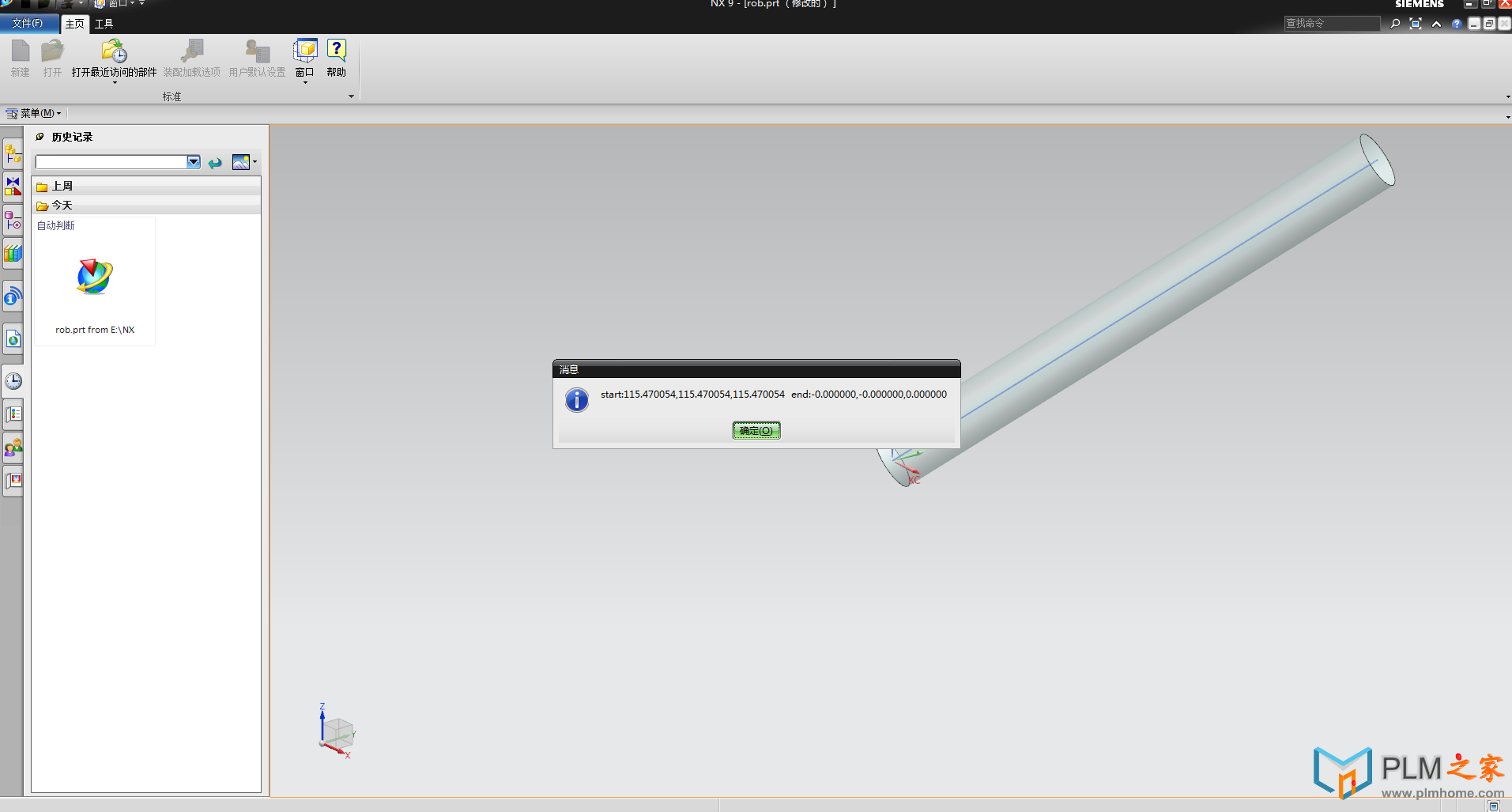
我把圆柱的方向设成【1,1,1】,成功了' I0 U1 F* @& B$ V
$ {) a( [6 E& c( J0 n |
-
评分
-
查看全部评分
|




 发表于 2015-4-21 21:14:38



 发表于 2015-4-22 11:10:39